
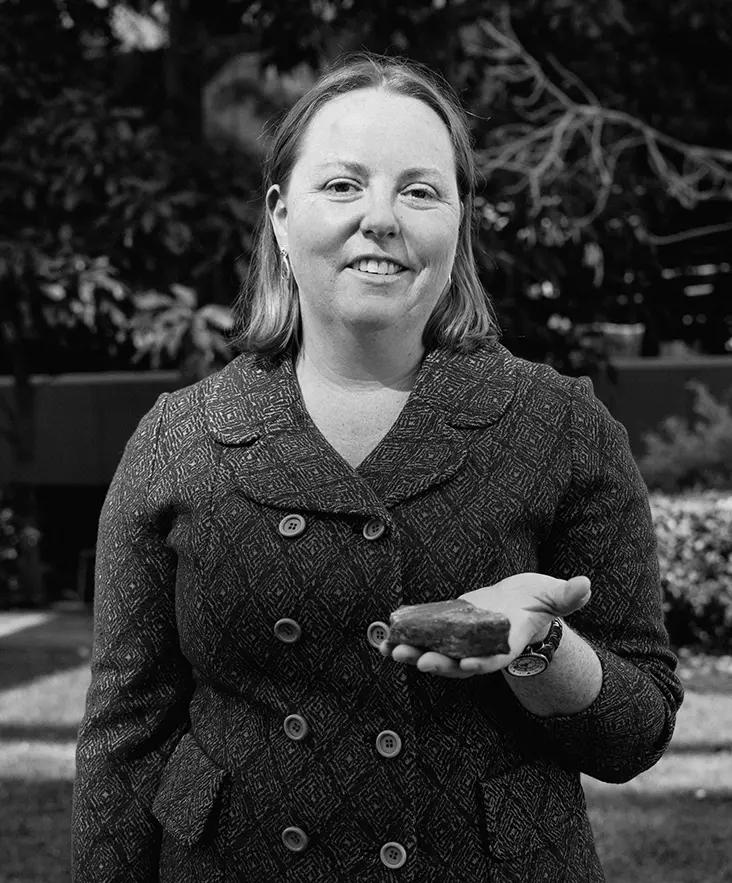
“Keep going until I say stop, or you run out of drill rods…”
This was the call made by Perth-based geologist Dr Margy Hawke on Anzac Day 2009, as she instructed the final campaign of a 2,000m RC drilling program on a highly speculative tenement 150km north of Meekatharra, a small town in the Murchison region of Western Australia.
Dr Hawke, who was only 25 years of age at the time, was part of a geology team for Sandfire Resources, which included technical director John Evans and Allan Wynne, the Company’s long-standing office geologist.
On the surface the program was like any typical exploration play, having to manage mechanical difficulties on the rig, operating with poor communications coverage, and continuing to motivate a tiring operating team after a gruelling schedule.
Despite the conditions and narrowing window to make a discovery, compounded by two ‘fieldies’ deciding to head to town: one to go shopping and the other to have a truck fixed, Dr Hawke remained steadfast on seeing through the well-planned geology strategy.
The original focus was to look for gold given the region was well known for the precious metal, by exploring at depth and along strike. In the months previous, the geology team had decided to re-assay samples from prior drilling, focused on cuttings from two drill holes that comprised some of the best gold intercepts, as well as mineralised zones from a further nine drill holes.
This persistent, sound geology strategy and Dr Hawke’s intuition p drill rig to push the drill rig onward resulted in Sandfire unearthing the DeGrussa copper-gold deposit, which went on to become Western Australia’s largest copper mine. It still sits among the top echelon of Australia’s copper discoveries, in the same class as BHP’s Olympic Dam project in South Australia and Glencore’s Ernest Henry project in Queensland.
The commercial outcomes from the discovery catapulted Sandfire from a fledging junior mining explorer into a billion-dollar market-cap company and a serious commodities player, producing an estimated 300,000 tonnes per annum of high-grade copper concentrate.
In an exclusive interview with YIELD, Dr Hawke opens up on the moment she knew they had found something significant, and what her plans are for her next big target.
“I still smile at the irony of what happened with DeGrussa, given our primary focus was to land a shear hosted gold deposit, Copper wasn’t even on our radar,” Dr Hawke recalls.
“With DeGrussa, persistence was absolutely key for us as it would have been so easy to demobilise and head home after some initially disappointing drill results. But we stuck with the plan and made important onsite decisions during the final drill campaign.”
The first hole, which was logged as DGRC083, was orientated at -60 degrees to the north and abandoned after the drill-bit became bogged from intersecting cherty and brecciated material, the host rock of the gold mineralisation.
The mood and situation were compounded after subsequent drill hole results were disappointing, with only small amounts of mineralised material intersected.
However, sulphide had been intercepted within dolerite rocks in some end-of-hole samples, that hadn’t seen in any previous drill program across the tenements.
“It was getting late in the day, the team was tired and we’d already had to manage a series of mechanical issues on site: everything was pointing towards packing up and heading home,” Dr Hawke recalls.
“And that’s when I made the call to re-position the rig so it was six metres north of the original failed hole, to drill a vertical stratigraphic hole to prevent any further collapse.
“Like the previous hole, we passed through the mineralised chert breccia, then intersected a lot of barren clays.
“And then it happened, at 98 metres, the dust on the rig went from white to black, the samples being drilled were much heavier than anything previous.
“We had intercepted the top of the chalcocite cap of the DeGrussa massive sulphide, what followed was about 100m of solid massive sulphide, probably more, as the ground water overwhelmed the rig and we had to end the hole early.
“At that point I stepped out 20 metre to the north and drilled another hole, again intercepting another 100 metre thick sequence of massive sulphide. Another 20 metre step out to the north resulted in us intercepting malachite, azurite (both copper bearing minerals) and native copper in the supergene clay zone, before again intercepting more massive sulphide at depth.
“This is when we knew without doubt that we’d discovered something big, very big.”
Dr Hawke then did what anyone would do back in 2009, she took took her mobile phone, which was a modern Nokia 3310 of the era, and photographed the sample.
She drove her vehicle to higher ground to ensure she had phone reception, where she relayed the situation back to head office, which was initially silent as the significance of the news started to sink in.
“Looking back it’s really quite a remarkable feat to think we made the discovery without today’s technologies, while there was no luxury of Starlink or Wi-Fi communications available.
“As a geologist seeing the discovery turn into a major producing mine is awesome: it’s why we do what we do and what drives us for the next major target.”
Dr Hawke has her sights firmly set on the next target in her new role as Managing Director of Stockton Mining, which is doing an IPO to list its assets in the western Tanami region of the Northern Territory on the ASX.
“At the moment I’ve set my sights on the Tanami and with a clever exploration strategy, we hope to find the next world-class gold deposit similar in scale to Newmont’s Callie Gold Mine of 15 million ounces of gold,” she says.
“The exciting thing is that we’re drill ready, which means as soon as we ring the ASX bell we’ll be on the ground collecting samples.”
Stockton Mining has consolidated a large 4,491km2 package of exploration tenure in the Northern Territory’s Tanami region, including a legacy resource of 114,900 oz at 4.7g/t, located 100km west of Callie.
Dr Hawke is joined by Ben McCormack, a pre-eminent structural geologist who has consulted to the world’s largest gold explorers and miners for more than a decade.
“Our priority target indicates an area with folded Dead Bullock Formation and large cross cutting structures, which is analogous to Callie,” she explains
“By the end of this year we’ll have more data and results that we hope will put us a significant step closer to making Stockton’s assets the next DeGrussa.”
Luke Derbyshire